
Our Guide to Creating an FF&E Schedule
Updated: January 2026
FF&E is an acronym for Furniture, Fixings and Equipment. It represents all of the tangible items that you need in order for your business to function (and to look great). The amount of FF&E required when setting up a new business, such as a hotel or restaurant, is extensive, and its procurement and installation can be a huge task. This is where an FF&E schedule is required. Here is our guide to understanding and creating an FF&E schedule that will make your interior design procurements and installation process simpler.
What is the procurement of FF&E?
FF&E procurement is not just simply placing orders; it’s a comprehensive process that manages the entire journey of your furniture, fixtures and equipment.
- Sourcing and specification involves identifying the right suppliers, validating their credentials and defining exact FF&E requirements (materials, dimensions, colours, etc.)
- Budgeting and purchasing require obtaining quotes, negotiating terms, managing purchase orders, and managing cash flow. Procurement professionals can often secure better pricing through established supplier networks.
- Logistics and delivery coordinates warehousing, shipping schedules, customs clearance (for international items), and on-site delivery. Bespoke items take longer, understandably.
- Installation and handover oversees the assembly, placement, styling, spacing and final sign-off.
- Quality control and risk management are exercised throughout the process, preserving investments and ensuring final assembly mirrors design briefs. This includes pre-shipment inspections, damage prevention, and contingency planning for potential delays or issues.
What is an FF&E schedule?
An FF&E schedule is a way of documenting the precise details surrounding all of the furniture, fixings and equipment. It breaks down all of your requirements by room (and in some cases, by area of the room) to ensure that you know exactly what items you will need and want during the interior design phase, and exactly how they should look.
Your FF&E schedule will quickly become your main focal point once construction is complete.
Why is an FF&E schedule essential?
Creating a comprehensive FF&E schedule is essential for project success. Here’s why it matters:
- It keeps everything organised in one place, acting as a single source of truth.
- It ensures everyone is on the same page, acting as a communication bridge between designers, contractors, suppliers and clients.
- It controls budgets more effectively, with all costs tracked in real-time, allowing you to make informed decisions about where to economise.
- It streamlines procurement and installation processes by mapping out lead times, delivery dates and installation plans.
- It facilitates the process of coordinating complex logistics across multiple suppliers, preventing bottlenecks and helping you avoid expensive delays.
- It improves accuracy and minimises errors by giving manufacturers and suppliers access to all they require.
What should be included in an FF&E schedule?
A comprehensive FF&E schedule serves as your project’s central control document. While every project is unique, these essential components should feature in your schedule:
- Item descriptions and specifications (name, manufacturer, model number, finish, colour, dimensions, etc.)
- Quantities of every FF&E item needed
- Room placement and location (requiring a detailed FF&E floor plan, in many cases)
- Budget and costs listed, with taxes, shipping fees, and total expenditure noted
- Vendor and supplier details, including order reference numbers and contact information
- Order status of all items (e.g., specified, ordered, in production, in transit, delivered, installed)
- Timeline and lead times, with order dates, and expected delivery and installation dates
You may also find it helpful to include local regulatory standards, brand guidelines, warranty information, and care instructions, particularly for luxury hospitality projects where maintenance teams will need ongoing reference material.
How to manage and maintain your FF&E schedule
Regular updates are essential as items move through the procurement cycle. Update status columns when orders are placed, when shipments leave the factory, when items arrive at your warehouse, and when installation is complete. This keeps everyone informed and helps you spot potential issues early.
Choose the right format for your needs – Many designers and project managers use spreadsheet software like Microsoft Excel or Google Sheets, which offer flexibility, easy sharing, and the ability to create custom formulas for budget calculations. More complex projects might benefit from dedicated project management or interior design software that integrates FF&E scheduling with other project elements.
Collaborate effectively by storing your schedule in a shared location where all stakeholders can access the latest version. Communicate regularly with your team to ensure procurement is progressing on schedule and address any delays or issues proactively rather than reactively.
What should an FF&E schedule look like?
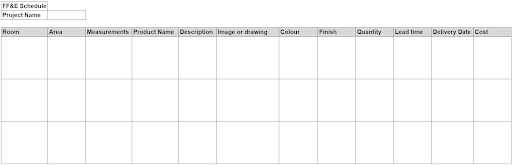
A basic FF&E schedule should follow the format below, however there may be additional information that you would like to include. If you are not working from a separate budget sheet, or want to keep an extra eye on costs, you can also use this schedule to keep track of your spend.
FF&E schedule best practices
Having created FF&E schedules for countless projects across numerous sectors, we’ve learned what separates successful implementations from problematic ones:
- Start early: Begin building your schedule when design phases are underway, to give you a realistic view of lead times, allowing you to adjust specifications if needed.
- Allow more time: Factor in buffer time and contingency plans for potential delays, which are common in international shipments.
- Document everything: Include reference numbers, notes, special arrangements and more. The more detail, the better.
- Communicate changes immediately: If specifications or project needs change, update your schedule and inform all stakeholders right away.
- Use clear names: Implement clear, consistent naming conventions for items, rooms and allocations.
We know that the FF&E planning and installation process can be time-consuming and extensive, so why not speak to a company like Momentous? We offer FF&E interior services and have expertise that extends from interior design to FF&E installation – and everything in between.
We are members of a number of professional associations including the British Institute of Interior Design, which means we agree to follow a strict code of conduct and keep up to date with professional developments.
Get in touch with our team today – we’d love to discuss your project.